Review a specification before the design review
A functional specification checked against the schematics and the house coding guideline, written up as a review table, most severe first.
- Team
- Engineering
- Typed by
- Controls lead
- Works with
- Functional specification (PDF), Schematics E01–E03 (DXF), PLC coding guideline, House PLC library
- Delivers
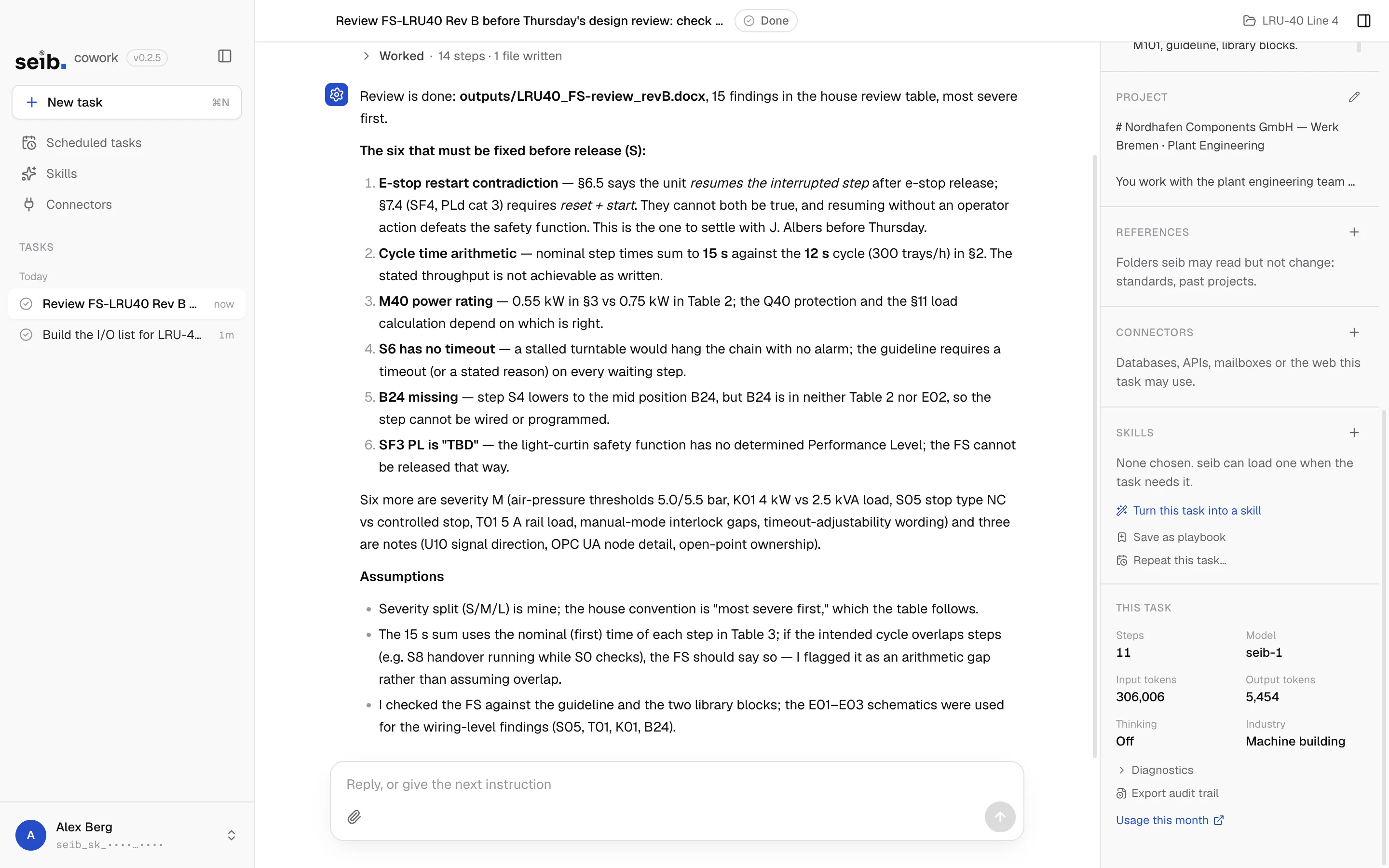
- Word review, 15 findings with section and page
The request, as typed
Review FS-LRU40 Rev B before Thursday's design review: check it against the schematics and our PLC coding guideline, and write the review as outputs/LRU40_FS-review_revB.docx in our review table, most severe first.
What it did.
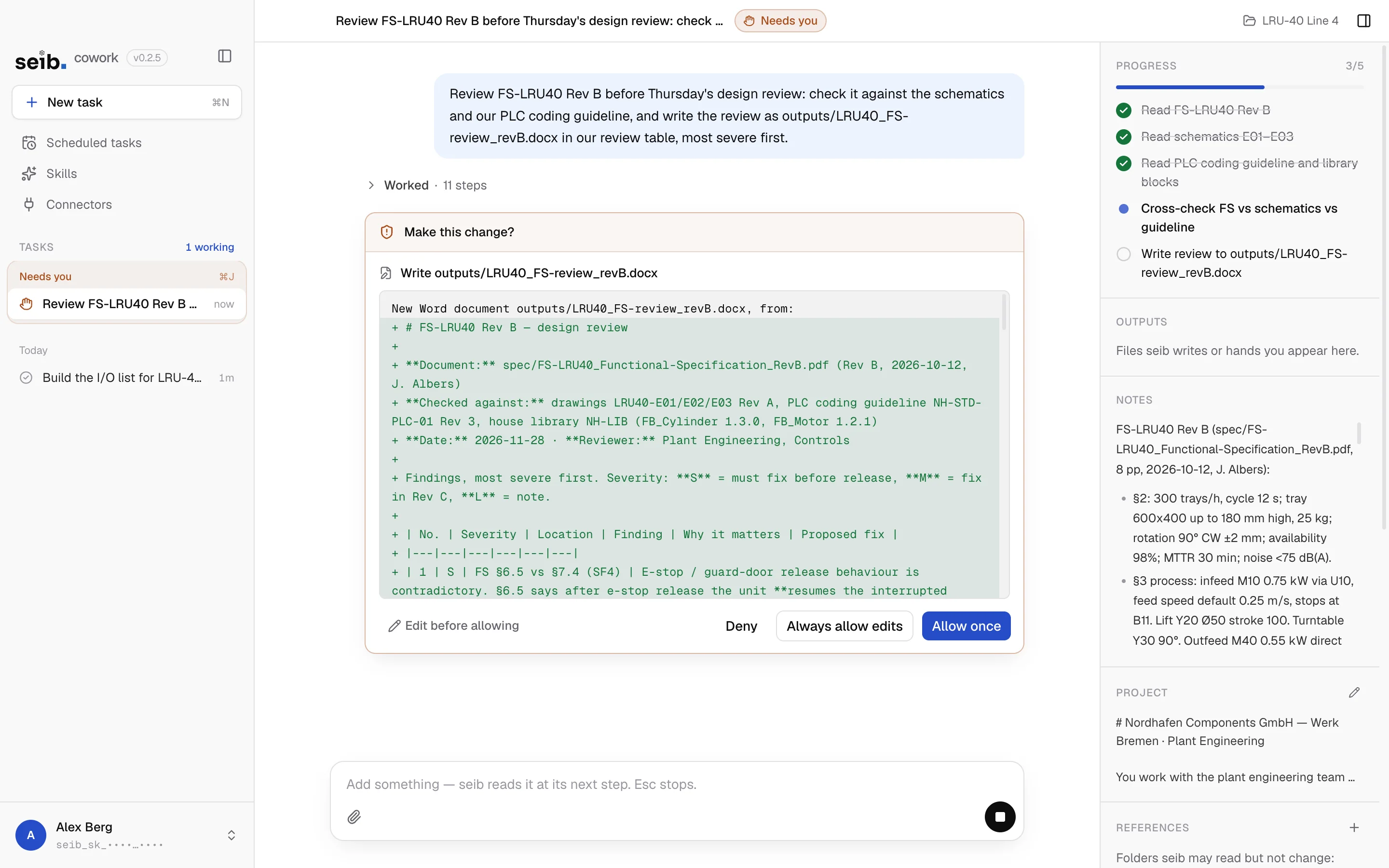
It stopped to ask before writing the Word file, shown in full.
- 1
Planned the review in five steps and kept the plan visible as it worked.
- 2
Read the specification and kept notes on its tables, sequence and safety functions.
- 3
Read the three schematic sheets, the PLC coding guideline and the two house library blocks.
- 4
Cross-checked the specification against the drawings and the guideline.
- 5
Wrote the review in the house table — number, severity, location, finding, why it matters, proposed fix — and asked before saving it.
What came back.
Fifteen findings, six of them must-fix: §6.5 lets the unit resume after an emergency stop while safety function SF4 in §7.4 requires reset and start; the nominal step times add up to 15 s against a 12 s cycle; motor M40 is 0.55 kW in one section and 0.75 kW in another; step S6 has no timeout; sensor B24 is used in the sequence but exists on no drawing; and the light curtain's performance level is still "TBD".
Every screen is a capture of seib Cowork 0.2.5 running the request shown with seib-1, the real model, with no step scripted. The systems and documents are seib’s test environment: two fictional companies, Nordhafen Components (a machine-building plant) and the Brennholt Group (a six-company group), with generated data. Where a folder carries project instructions, such as the names of a database’s tables, the run used them, as a customer’s would. Names, keys and file paths of the machine that ran it are masked; nothing else on a screen is changed. No customer data appears.
More use cases.
All 9- Find what is holding a line backOne question across the MES, the maintenance system and the ERP: what is down, what work is open, and which part nobody has ordered.
- Trace a supplier's delay to the machineA delay mail followed through the ERP, the maintenance system and the MES — and a reply not written when the data said it would be wrong.
- Chase overdue purchase orders, every MondayThe overdue orders from the ERP in plain words, the three suppliers to call first, and the request saved to run itself each week.
Request pilot access.
Not a waitlist. Tell us the problem and we’ll tell you honestly whether seib is ready for it.
- 1A person reads your request and replies within a few business days.
- 2A short call about the line, the toolchain and what's slow today.
- 3A Cowork pilot starts with one team, read-only connectors and two or three knowledge bases.