Build an I/O list from the drawings
Card, channel, address and terminal read from three schematic sheets into the house Excel template, with every place the spec and the drawings disagree.
- Team
- Engineering
- Typed by
- Controls engineer
- Works with
- Functional specification (PDF), Schematics E01–E03 (DXF), House I/O list template (Excel)
- Delivers
- Filled I/O list, one row per wired channel
The request, as typed
Build the I/O list for LRU-40 from the functional specification and the schematics E01–E03, in templates/io-list-template.xlsx, and save it as outputs/LRU40_IO-list_revA.xlsx. Take card, channel, address and terminal from the drawings. List every signal where the spec and the drawings disagree.
What it did.
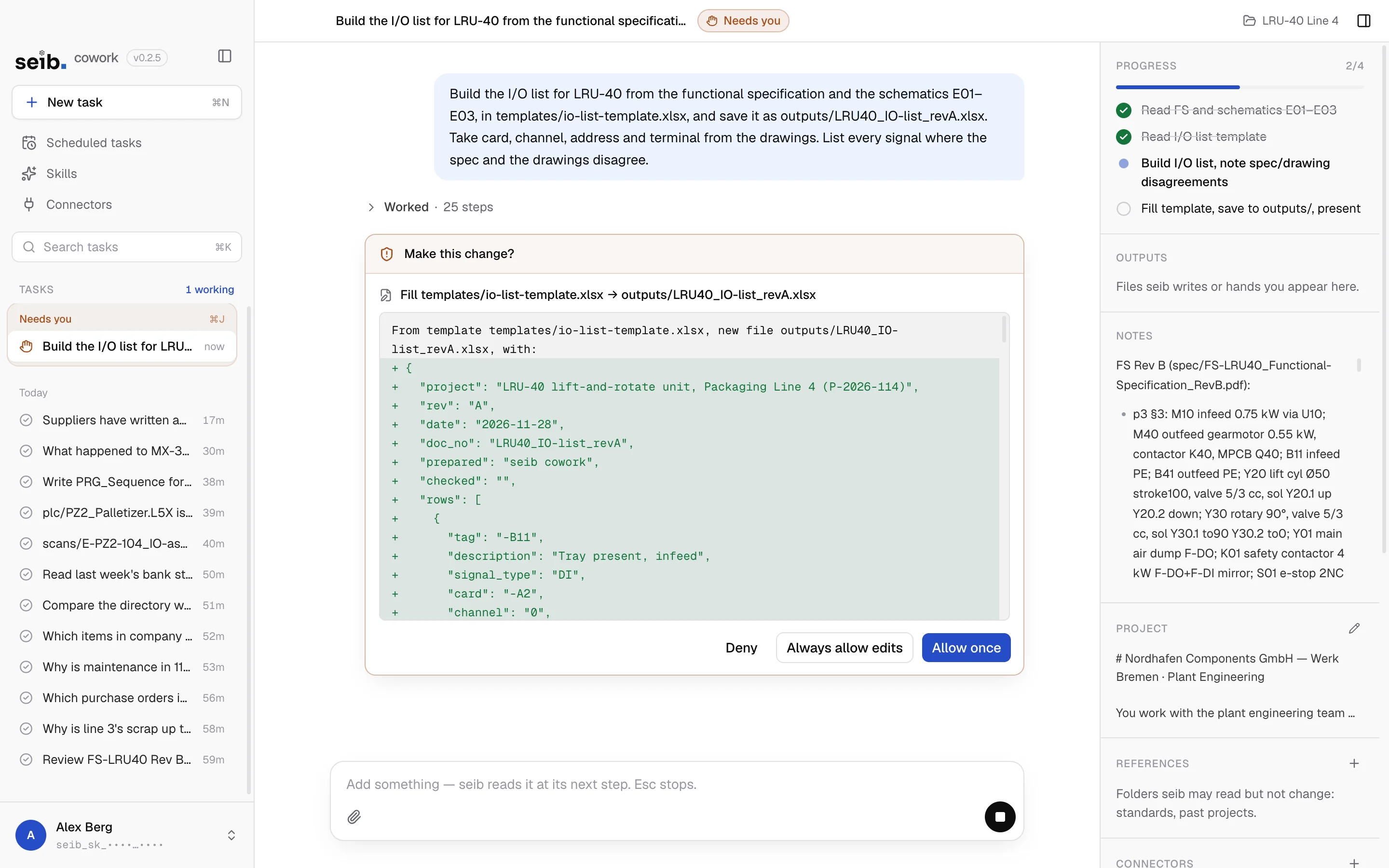
It stopped to ask before filling the template, and before running the command that added the open-issues table.
- 1
Planned the task, then read the functional specification and the three schematic sheets, keeping notes as it went.
- 2
Read the house I/O list template to see its columns and placeholders.
- 3
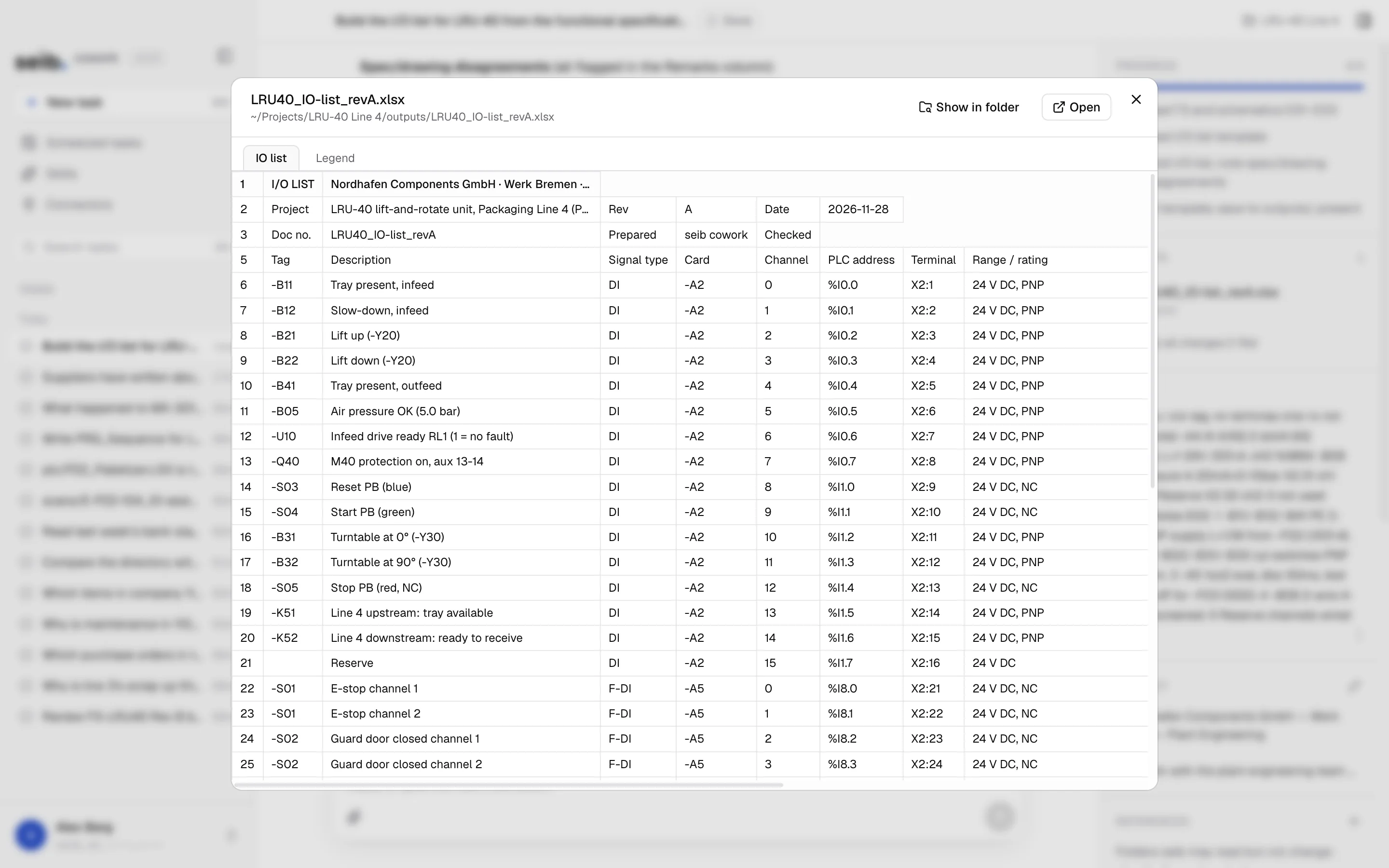
Built one row per wired channel — tag, description, signal type, card, channel, address, terminal, rating, safety function and source — and filled the template after asking.
- 4
Added an open-issues table for the disagreements with a short Python command, which it showed and ran only after approval.
What came back.
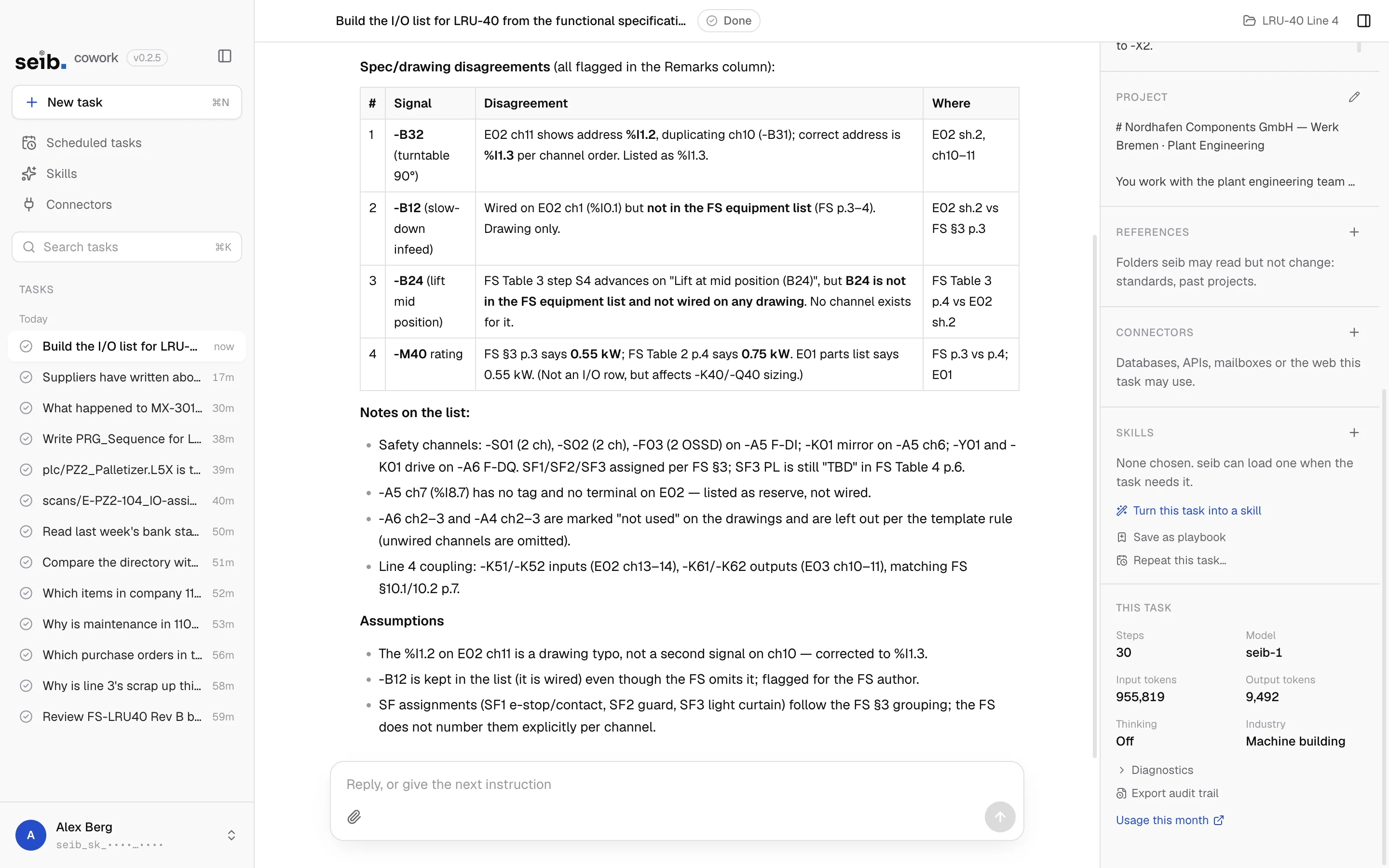
A filled I/O list in the house template, every row citing the drawing sheet it came from, and four disagreements: -B32 shares address %I1.2 with -B31 on E02 (listed as %I1.3); -B12 is wired but not in the specification; -B24 is used in sequence step S4 but is on no drawing; and motor M40 is 0.55 kW in one section and 0.75 kW in another. It said which of these it corrected in the list and which it only flagged.
Every screen is a capture of seib Cowork 0.2.5 running the request shown with seib-1, the real model, with no step scripted. The systems and documents are seib’s test environment: two fictional companies, Nordhafen Components (a machine-building plant) and the Brennholt Group (a six-company group), with generated data. Where a folder carries project instructions, such as the names of a database’s tables, the run used them, as a customer’s would. Names, keys and file paths of the machine that ran it are masked; nothing else on a screen is changed. No customer data appears.
More use cases.
All 9- Review a specification before the design reviewA functional specification checked against the schematics and the house coding guideline, written up as a review table, most severe first.
- Find what is holding a line backOne question across the MES, the maintenance system and the ERP: what is down, what work is open, and which part nobody has ordered.
- Trace a supplier's delay to the machineA delay mail followed through the ERP, the maintenance system and the MES — and a reply not written when the data said it would be wrong.
Request pilot access.
Not a waitlist. Tell us the problem and we’ll tell you honestly whether seib is ready for it.
- 1A person reads your request and replies within a few business days.
- 2A short call about the line, the toolchain and what's slow today.
- 3A Cowork pilot starts with one team, read-only connectors and two or three knowledge bases.