Write a step chain in Structured Text
The automatic sequence of a specification written as IEC 61131-3 Structured Text, to the house coding guideline, using the house library unchanged.
- Capability
- Code
- Typed by
- PLC programmer
- Works with
- Functional specification (PDF), PLC coding guideline, House library block FB_Cylinder, Released I/O list
- Delivers
- PRG_Sequence.st, one POU
The request, as typed
Write PRG_Sequence for LRU-40 in Structured Text: the automatic step chain of FS §5, per plc/PLC-coding-guideline.md, using the FB_Cylinder block from plc/library unchanged. Addresses only from released/LRU40_IO-list_revA.xlsx. Save it in outputs/plc/.
How the run worked.
seib-1 never touches a file or a system. It writes each next step as a tool call; seib Cowork checks it, runs it, and sends the result back. Anything that writes waits for a person.
In
What it read
- Functional specification (PDF)
- PLC coding guideline
- House library block FB_Cylinder
- Released I/O list
Model
seib-1
- Plans the task
- Writes each next step as a tool call
- Reads every result before the next
Desktop
seib Cowork runs
- read_file: specification pages, guideline, library block, I/O list
- write_file
Person
Approves
- Asked before writing the file, shown line by line.
- Out: PRG_Sequence.st, one POU
Inside the run.
Turns from this run, word for word: the tool calls seib-1 wrote, in the format seib Cowork reads, and what came back. Shortened only where an ellipsis says so.
- 01seib-1Tool call
<tool_call> {"tool": "read_file", "input": {"path": "spec/FS-LRU40_Functional-Specification_RevB.pdf", "pages": "4-6"}} </tool_call> - 02CoworkTool result
spec/FS-LRU40_Functional-Specification_RevB.pdf, pages 4-6 of 8 (15.8 KB), are attached to this message. Cite page numbers of the original document.
- 03seib-1Tool call, shortened
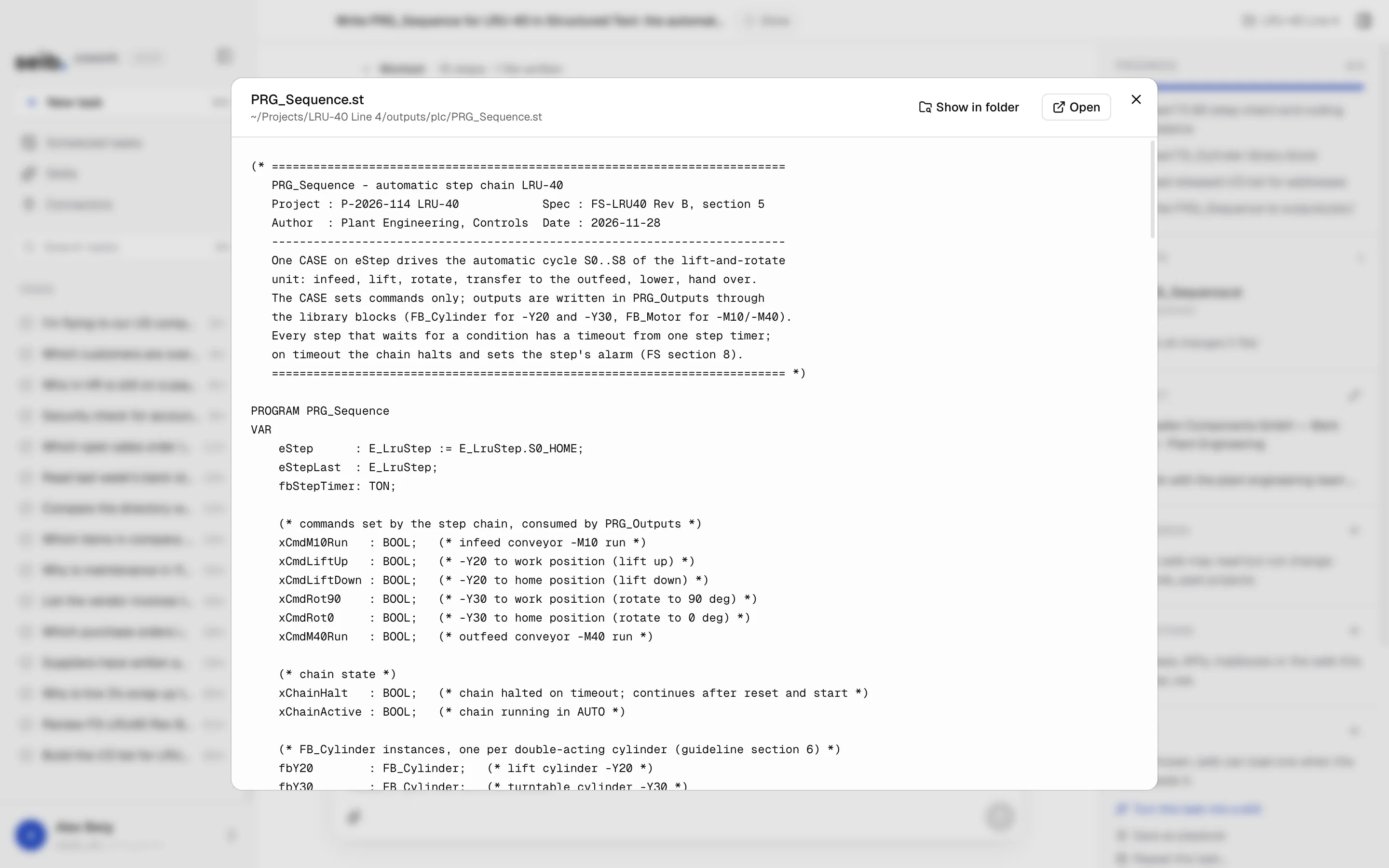
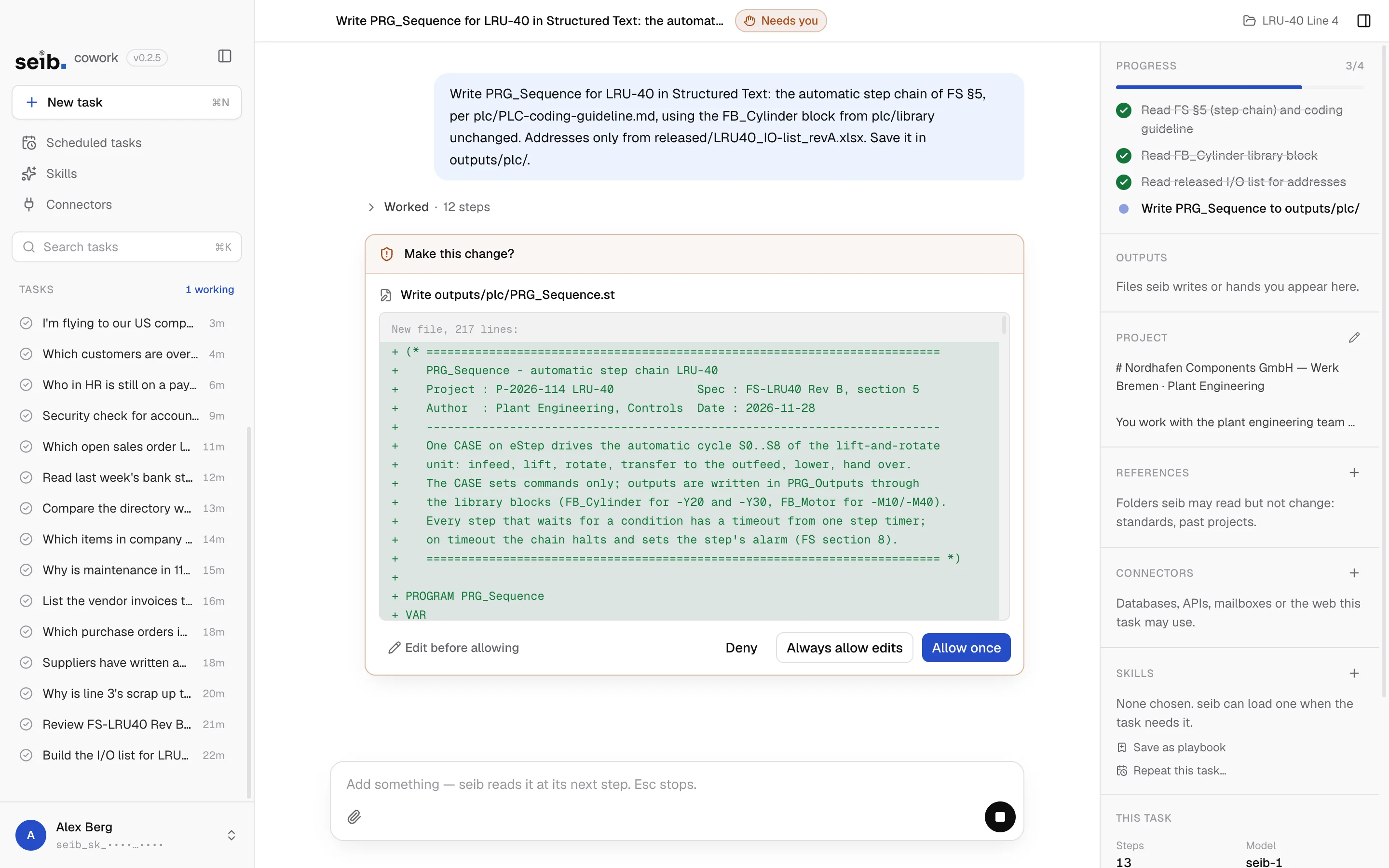
<tool_call> {"tool": "write_file", "input": {"path": "outputs/plc/PRG_Sequence.st", "content": "… CASE eStep OF S0_HOME: (* S0: home position - lift down, turntable at 0 deg, conveyors stopped. *) (* No timeout: the home position is the machine's rest state; a cylinder *) (* that cannot reach it is reported by its own FB_Cylinder timeout. *) xCmdLiftDown := TRUE; xCmdRot0 := TRUE; xCmdM10Run := FALSE; xCmdM40Run := FALSE; IF fbY20.xAtHome AND fbY30.xAtHome THEN eStep := S1_INFEED; END_IF; S1_INFEED: (* S1: infeed - M10 runs, wait for a tray at B11. *) xCmdM10Run := TRUE; …"}} </tool_call> - 04CoworkAfter approval
Created outputs/plc/PRG_Sequence.st (217 lines).
What it did.
It stopped to ask before writing the file, shown line by line.
- 1
Read the step table and alarms in the specification, the coding guideline, the FB_Cylinder block and the released I/O list.
- 2
Wrote one CASE on an enum step variable, S0_HOME to S8_HAND_OVER, setting commands only, with outputs left to PRG_Outputs as the guideline requires.
- 3
Gave every waiting step a timeout from one step timer, with the limits as named constants and the specification's alarm numbers.
- 4
Showed the 217-line file for approval before writing it.
What came back.
PRG_Sequence.st follows specification §5 and the guideline: FB_Cylinder instances fbY20 and fbY30 used unchanged; a halt on timeout that waits for reset and start; and S0 without a timeout, with the comment the guideline asks for. It flagged that step S4 depends on sensor -B24, which exists on no drawing, rather than inventing an address for it.
Every screen is a capture of seib Cowork 0.2.5 running the request shown on seib-1, the real model, with no step scripted. The systems and documents are seib’s test environment: two fictional companies, Nordhafen Components (a machine-building plant) and the Brennholt Group (a six-company group), with generated data. Where a folder carries project instructions, such as the names of a database’s tables, the run used them, as a customer’s would. Names, keys and file paths of the machine that ran it are masked; nothing else on a screen is changed. No customer data appears.
More use cases.
All 4- Explain a trend from the historianA week of vibration data from the historian, charted and explained, and checked against the maintenance system for a work order.
- Read a 1998 scan into a spreadsheetA photocopied I/O sheet, read by sight into Excel, with the smudged tag and the handwritten correction flagged rather than guessed.
- Audit a PLC program exportA Rockwell L5X export checked for unused tags and undocumented alarms, and against the old machine's I/O: including logic that isn't there.
Request pilot access.
Not a waitlist. Tell us the problem and we’ll tell you honestly whether seib is ready for it.
- 1A person reads your request and replies within a few business days.
- 2A short call about the line, the toolchain and what's slow today.
- 3A Cowork pilot starts with one team, read-only connectors and two or three knowledge bases.