Audit a PLC program export
A Rockwell L5X export checked for unused tags and undocumented alarms, and against the old machine's I/O: including logic that isn't there.
- Capability
- Engineering formats
- Typed by
- Controls engineer
- Works with
- Rockwell L5X export, The 1998 I/O transcription
- Delivers
- Word review of the program
The request, as typed
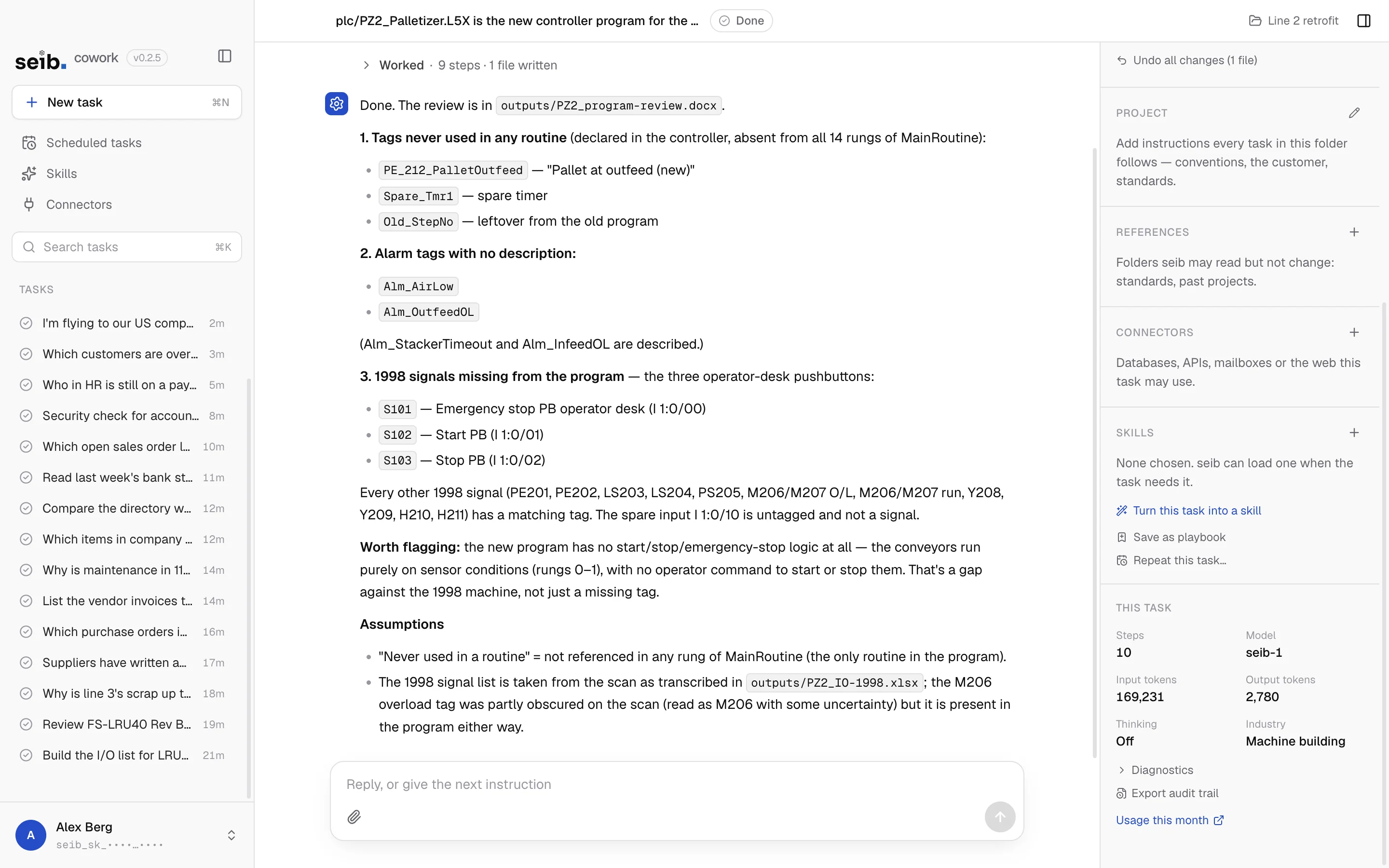
plc/PZ2_Palletizer.L5X is the new controller program for the palletizer. Which tags are never used in a routine, which alarm tags have no description, and which signals from the 1998 scan in scans/ are missing from the program?
How the run worked.
seib-1 never touches a file or a system. It writes each next step as a tool call; seib Cowork checks it, runs it, and sends the result back. Anything that writes waits for a person.
In
What it read
- Rockwell L5X export
- The 1998 I/O transcription
Model
seib-1
- Plans the task
- Writes each next step as a tool call
- Reads every result before the next
Desktop
seib Cowork runs
- read_file: L5X summarised, then raw
- read_file: the scan and its transcription
- write_docx
Person
Approves
- Asked before writing the review.
- Out: Word review of the program
Inside the run.
Turns from this run, word for word: the tool calls seib-1 wrote, in the format seib Cowork reads, and what came back. Shortened only where an ellipsis says so.
- 01seib-1Tool call
<tool_call> {"tool": "read_file", "input": {"path": "plc/PZ2_Palletizer.L5X"}} </tool_call> - 02CoworkTool result, shortened
plc/PZ2_Palletizer.L5X — Rockwell L5X, summarised (raw: true for the file itself):
Rockwell Studio 5000 export (33.01), target Controller PZ2_Palletizer
Controller PZ2_Palletizer: 1769-L33ER, revision 33.11

## Modules (3)
- Local: 1769-L33ER, parent Local
- DI16: 1769-IQ16, parent Local
- DO16: 1769-OB16, parent Local

## Controller tags (24)
- PE_201_PalletInfeed: BOOL — Pallet at infeed (PE201)
- PE_202_PalletStacker: BOOL — Pallet at stacker (PE202)
…
- 03seib-1Tool call
<tool_call> {"tool": "read_file", "input": {"path": "plc/PZ2_Palletizer.L5X", "raw": true}} </tool_call> - 04CoworkTool result, shortened
plc/PZ2_Palletizer.L5X, lines 1–145:
    1  <?xml version="1.0" encoding="UTF-8" standalone="yes"?>
    2  <RSLogix5000Content SchemaRevision="1.0" SoftwareRevision="33.01" TargetName="PZ2_Palletizer" …
What it did.
It stopped to ask before writing the review.
- 1
Read the L5X export: controller, modules, tags and the 14 rungs of the main routine.
- 2
Read the 1998 scan and the transcription made from it.
- 3
Compared declared tags with the rungs, alarm tags with their descriptions, and old signals with new tags.
- 4
Wrote the review to Word, after asking.
What came back.
Three tags no routine uses, two alarm tags with no description, and three 1998 signals missing — the emergency stop, start and stop pushbuttons. Without being asked, it pointed out what that means: the new program has no start, stop or emergency-stop logic at all, and the conveyors run on sensor conditions alone.
Every screen is a capture of seib Cowork 0.2.5 running the request shown on seib-1, the real model, with no step scripted. The systems and documents are seib’s test environment: two fictional companies, Nordhafen Components (a machine-building plant) and the Brennholt Group (a six-company group), with generated data. Where a folder carries project instructions, such as the names of a database’s tables, the run used them, as a customer’s would. Names, keys and file paths of the machine that ran it are masked; nothing else on a screen is changed. No customer data appears.
More use cases.
All 4- Write a step chain in Structured TextThe automatic sequence of a specification written as IEC 61131-3 Structured Text, to the house coding guideline, using the house library unchanged.
- Explain a trend from the historianA week of vibration data from the historian, charted and explained, and checked against the maintenance system for a work order.
- Read a 1998 scan into a spreadsheetA photocopied I/O sheet, read by sight into Excel, with the smudged tag and the handwritten correction flagged rather than guessed.
Request pilot access.
Not a waitlist. Tell us the problem and we’ll tell you honestly whether seib is ready for it.
- 1A person reads your request and replies within a few business days.
- 2A short call about the line, the toolchain and what's slow today.
- 3A Cowork pilot starts with one team, read-only connectors and two or three knowledge bases.